
Few things in life are certain, especially when it comes to cats. They’re cute and lovable, but also fiercely independent and prone to behaving in mysterious ways, sometimes even downright odd. But one thing’s for sure: cats love to rub on things, including people.
It seems weird; after all, humans don’t feel the need to rub on everything they see, and most other animals don’t either. Yet for cats, this behavior is so prevalent that one can’t help but wonder: why? Read on to unravel the mystery of the ever-rubbing cat and decode this fascinating behavior.
Communication is Key: The Unique Language of Cats
The Nose Knows
Humans have many ways of communicating, from spoken and written words to facial expressions to body language. Cats may not be able to write or maintain such broad vocabularies as humans do, but they are similar in that they use multiple modes of communication. They can produce a diverse array of sounds and they have a highly refined body language, like us, but a large amount of their communication is carried out via scent.
A cat’s nose may not be as sensitive as a dog’s, but it’s still remarkably more active than a human’s – compare our 5 million scent receptors to a cat’s 200 million! It doesn’t stop at the nose, either; cats have a special organ in their mouths called the vomeronasal organ which also detects scent. With such an acute sense of smell, it’s no surprise that cats make the most of it by communicating through scent.
The Undetectable Language
We can smell some forms of feline scent communication. Intact male cats will spray urine over what they consider their territory. It’s unpleasant for us, but to the cat, it’s just his way of telling other cats what belongs to him.
For the most part, though, humans can’t smell the scents made by cats, which are called pheromones. Though pheromones are usually thought of as signals that an animal is ready to mate, cats use pheromones for much of their day-to-day discussion beyond that. The glands that produce them are found all over the body, from the mouth and all parts of the face to the lower back, paws and tail.
A Lasting Personal Message
The cat activates these pheromone glands by rubbing them against something to release the scent, which is specific to each individual and remains where it was left for some time after. Should another cat come along later, the first feline’s unique pheromones would still be there, relaying the message like a sticky note left on a colleague’s desk. It’s a very efficient way of communicating, effective even when the original speaker is no longer present.
Of course, nothing lasts forever, and eventually the smell fades. In some cases, it may be covered up prematurely by another cat’s pheromones, or even another animal altogether. Cats can be very fastidious in maintaining their pheromone markings, rubbing the same spot again and again to make sure their message remains clear and strong.
Decoding the Cat: What Do the Pheromones Mean?
A Diverse Discussion
Cats produce many different pheromones, each released in a different way. The pheromones found in urine and, to a lesser extent, the cheek glands signal territory; the smell is an explicit signal to other cats to back off. A cat in heat gives off entirely different pheromones that are irresistible to any male cats that get a whiff of it.
The pheromones left behind by rubbing the face, flanks and tail, however, signal familiarity more than anything else. Cats value comfort in their environment and by rubbing on their surroundings (and the people within them) they fill the environment with their personal scent, which induces feelings of security. It’s similar to territorial marking, but much friendlier in nature; it’s the cat’s way of saying, “I’m comfortable with this.”
Born With It
The practice of marking familiar things with pheromones starts at a very young age. Mother cats mark their babies, and before long the babies begin to mark each other by butting their heads together. Cats of all ages practice this behavior (called “bunting“) with each other, with humans and sometimes even with other animals like dogs – it’s a sign of trust and friendship.
Even big cats partake in the act of familiarization via pheromones. Lions, being the most social of the big cats, are particularly fond of this behavior. They greet other members of the pride by bunting and frequently rub their heads, bodies and tails against their favorite trees and rocks.
Rubbing and You: How to Return the Sentiment
A Member of the Family
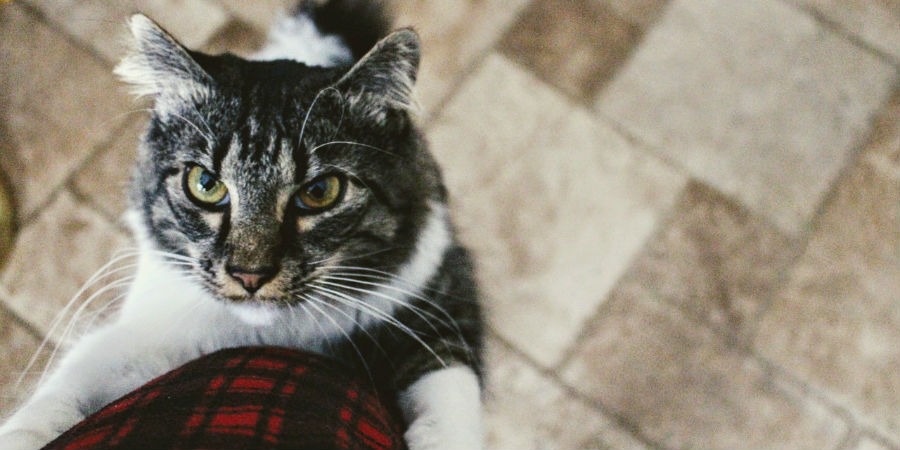
Here’s a scenario that’s bound to be all too familiar to any cat owner: you enter the room and your cat appears at your feet, rubbing your leg with its face and sides before concluding by wrapping its tail around you. By doing this, the cat brings you back into its group of comfortable things that it maintains through scent markings. For a cat, home is whatever smells like itself, and you’re no exception.
It’s an odd way to compliment someone, but from the cat’s point of view, headbutting is one of the highest forms of flattery. When a cat bunts with another cat, they exchange pheromones, which combine into a new scent that’s unique to the pair. Humans might not have those same pheromone glands, but when your cat head butts you, the sentiment is the same: the bond and trust you share is strong enough that the cat thinks you should smell like each other.
Reciprocating the Love
Humans can reinforce the friendliness and trust by doing what comes naturally: petting the cat, particularly right around the ears and on the cheeks. An affectionate scratch around the ears tells the cat that you return its feelings of trust and comfort, that the two of you feel at home with each other. To your cat, it’s the ultimate display of companionship and love. Learn more at https://CatCheckup.com